Thursday, October 29, 2020

Ecuador Space Connection


Former NASA satellite tracking station in Chile


Space Activity

 
In August 1957, the United States, through NASA (the National Aeronautics and Space Administration) installed on the slopes of Cotopaxi Volcano, a Satellite Tracking Station for the purpose of monitoring and controlling the orbit of American satellites.  
 
NASA rocket on the launch pad


In 1981, fifteen years after our visit to the satellite tracking station, NASA ended 25 year’s of tracking US space satellites in Ecuador and handed the station over to the Ecuadorian government.
 
In 1977 Ecuador created CLIRSEN (the Center for Integrated Natural Resources Remote Sensing). Starting in 1981 CLIRSEN gathered satellite data to produce maps for the planning and development of the country. Subjects covered included agriculture, aquaculture, environment, health and disaster preparedness. 
 
In 2007 Ecuador celebrated the 50th anniversary of the station. Beginning in 2012, the station was operated by a new Ecuadorian agency; the Ecuadorian Space Institute or IEE. The Institute continued the activities developed under CLIRSEN and took on new responsibilities related to space research.
 

Image based on an official photo of the Ecuadorian Space Institute
operating on the site of the former satellite tracking station


Cooperative Courses


Creating and presenting various courses for the cooperatives under my responsibility was my first introduction to teaching. As can be seen in my letters home, I thoroughly enjoyed the teaching experience.
 
Students in one of our cooperative classes 


My language failings bothered me throughout my Peace Corps service. Despite this weakness, I seem to have survived and been of a benefit to the country. Working primarily in the capital city where English knowledge was highly valued and possessing skills learned from an excellent economics education helped me considerably.

Despite my lack of fluency with Spanish conversation, I was able to design and create the courses in Spanish. I used my Spanish knowledge to translate English sources into Spanish and present the information to the cooperative students. Reviewing the lessons learned, we found the students successfully expanding  their understanding of the particular subjects involved. 


Weather Ills


Quito's Plaza Grande (or de Independencia) before a winter rain

The weather is not the most exciting subject for a place located almost two miles high and on the equator. Nevertheless, it can have a significant impact on one's health if care is not taken to protect oneself.  
 
The proposed trip to Manta could have a positive health impact, especially since hurricanes are not known to frequent Manta's coast. Getting to better know the country we are serving in is also a positive benefit of service in the Peace Corps. Our Manta experience will be described in the next post.


Tuesday, October 6, 2020

Walkout

Church and Plaza San Francisco, site of major credit cooperative in Quito,
H Graem © 1966


This church was the location of a cooperative I worked with in Quito. As I recall, it was a well run operation. Not much to add to my words of 1966 regarding our Volunteer work with the credit cooperatives and the politics of the national organization which resulted in the "Walkout" which is the title of this post. I do wonder if the Federation still exists and if it still oversees Ecuador's cooperatives at the national level.

According to RFILC, in 2020 the savings and credit cooperatives in Ecuador are second only to the banks in the financial sector. Cooperatives handle 10% of the national financial transactions. There are more than 430 cooperatives that serve about 1,800,000 clients, 60% of which are micro-enterprises (and 45% rural micro-enterprises). The majority of the cooperatives are predominantly urban. Information respecting the status of credit cooperatives in Ecuador in 2005 may be found here.


At the end of 1966, these persons in the above photograph were at work at the National Federation of Cooperatives Headquarters in Quito. Not present were Ecuadorian extentionists and Peace Corps Volunteers busy elsewhere in the country. The only Americans present were Dan Moriarty (CUNA) and one Peace Corps Volunteer, Hugh Graham.

 
National Federation of Cooperatives
Quito Headquarters


Photo above was taken at the market discussed in the letter, H Graem © 1966 
Otavalo market in 21st Century,
H Graem © 2007


Map showing location of Otavalo
and Ibarra in relation to Quito.


Mount Cayambe partially visible and crested with clouds on a return trip to Quito.
H Graem © 2007

Thursday, September 24, 2020

Vicentina

View of Vicentina barrio from adjoining vacant land with the Cayambe Volcano in the background


Settling In

 
Respecting the three Vicentina images above, the top one on the right shows the house where Bob and I lived on the first floor. The middle image shows Bob on the left with our two landlords who lived on the second floor. The woman on the right was their daughter. The animal being held is the coatimundi I mention in my letter. The bottom image is a view over Vicentina looking beyond the barrio to the gorge on the other side. 
 
Searching for furniture for our new home


I don't know the conditions experienced by most Volunteers living in Ecuador. As city dwellers, Bob and I lived in conditions similar to others we knew, both Volunteers and Ecuadorians who were our colleagues. We were expected to live like the average citizen of Ecuador. So buses, walking and an occasional taxi were our principal means of transportation. Living about 9,000 feet high and walking each day to work and where we ate our meals kept us in good shape.

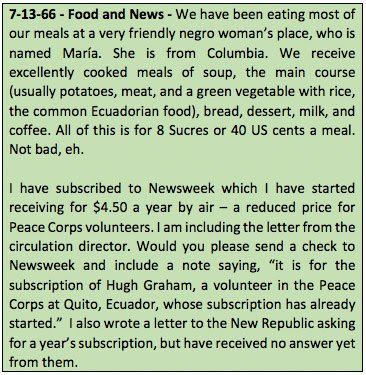
As can be read in my Food and News letter excerpt below, Maria was a popular provider of meals for numerous young people living away from home and trying to make a go of it in the big city. Maria's was a good place to meet volunteers working in other Peace Corps groups, Ecuadorian university students and volunteers working in other parts of the country who had traveled to Quito.

Getting news from the outside world appears to be more informal back in the 1960s, even in the USA. I can not imagine a Volunteer today arranging for a special subscription price with the circulation manager of a national magazine.

Another news source was the shortwave radio. I remember listening to the BBC most frequently, with the Voice of America also being available.
 
 
Maria & son Gonzalo prepared our meals 


A Teaching Success


One of our major responsibilities working with the credit unions in Ecuador was to improve the accounting standards of the individual cooperatives.  To achieve this goal we audited their books, trained employees, and provided classes for leaders and persons responsible for the day-to-day functioning of the cooperatives.
 
Another goal the National Credit Union Association was pushing involved production credit; encouraging the leaders to invest more cooperative funds and effort into production purposes rather than just consumer credit. The goal being to strengthen the economic level of the country.
 
I think the excerpt below speaks for itself. It seems pretty clear that I was quite pleased with my first teaching experience. 


Monday, September 14, 2020

Yaruquí

Some of us decided to add some excitement to our official beginning as Peace Corps Volunteers. What would be more exciting than our first Ecuadorian bullfight. Our experience at this event is described in the June 15 letter excerpt below.


Starting Work

 
In June 1966 there were four of us working with credit cooperatives in Quito. Beside myself, one was from New York City, one from Indiana, and the other (my roommate Bob Jensen) from Washington State. I had six cooperatives directly under my charge. However, we helped each other out, especially at this early stage when our Spanish was not the best. In the first week we analyzed the management and accounting of our coops. The second week we were supposed to make out a work plan until December. It didn’t get beyond July. 
 

Yaruquí Trip


The three Quito visitors to the Coop, starting second from left, are
Bob Jensen, Hugh Graham and Carlos Flores Romero


The above letter text written more than 50 years ago describes a Yaruquí that no longer exists. Yaruquí parish today includes a population of about 18,000 people. It has experienced major changes of great significance for Yaruquí, Quito and the country as a whole.  
 
Adjoining the northwest edge of the parish about 18 kilometers east of Quito a new airport has risen; Mariscal Sucre International Airport, the busiest airport in Ecuador. Beginning construction in 2006, it opened in February 2013 and replaced the old Mariscal Sucre International Airport. The new airport serves over 5 million passengers a year. 
 
The old airport posed enormous risks because it was located in the middle of a mountainous city with high wind currents. It could no longer be expanded to accommodate larger aircraft or increased air traffic.

Getting Acquainted

 
The 6-27-1966 letter excerpt below describes some of my contacts with Ecuadorians not involved with the credit cooperative movement. Regrettably, these acquaintances were fleeting and I lost contact over time.
 
Getting acquainted with some teenagers while on our first hike up Mt. Pichincha


Tuesday, September 8, 2020

Ride and Switch

1966 Bus-Train passengers taking a lunch break and the view traveling on top   

Reading my 1966 description of the train ride from Guayaquil to Quito, I fear the image of the ugly American may come to mind. The reality, which I remember well, presents a different picture. 

We were soon to be (we hoped) official Peace Corps Volunteers. On this train ride our minds were on more than the beautiful scenery passing by the windows. We were experiencing the anticipation and fear of a soon-to-be new period in our lives. Culminating all the difficulties of the recent months and the struggle navigating a different culture speaking another language, within the coming days we were to be "knighted" Volunteers or sent on our way to a future elsewhere. In the context, letting our hair down and enjoying a short-lived jubilant experience on a June day seems excusable.

Ferrocarril Transandino

Ecuador's rail system was started by President Gabriel García Moreno in 1861. It was devised to connect the Pacific coast with the Andean highlands. 

The push into the Andes was made under President Eloy Alfaro who planned to link Quito in the highlands to Guayaquil on the coast of Ecuador. For advice, Alfaro turned to Col. William Findlay Shunk, a well-known North American engineer. 

Modern tourist Crucero Train
on today's railroad

The Guayaquil and Quito railroad line was built between 1897 and 1908. The line reached Quito amidst celebration that lasted for days. Its completion shortened the often lengthy trip from Quito to Guayaquil to two days. Alfaro realized his dream of connecting the two most important parts of Ecuador.

The railway was severely damaged by heavy rainfall in 1997 and 1998 as well as from general neglect. In 2008 the president Rafael Correa named the railroad a "national cultural patrimony" and indicated that it would be restored. The government of Ecuador started to rehabilitate the railway and service was restored between Guayaquil and Quito by 2013.


The Switch
 
Our group trained to work with credit cooperatives in Ecuador. We completed initial training at Camp Crozier in the mountains of Puerto Rico. That training period is described in the first post. It lasted from March 4, 1966 to April 29, 1966. 
 
The final five weeks of training occurred in-country in Ecuador. This second period was split between two localities; (1) our prospective work site in Ecuador and (2) a final 10 days in Quito.  If we succeeded, in Quito we would be officially enrolled as Peace Corps Volunteers
 
It was during these last 10 days that I experienced the 'switch'. At some point I learned that I would be serving as a Volunteer working out of Quito, not Guayaquil. 
 
The main reason, although probably not the only one, for this significant change was mentioned in my June 15, 1966 letter home.  Two volunteer trainees who were expected to work in Quito had dropped out of the program and left the country. I was chosen by the Peace Corps Ecuador administrators to partially fill this gap.    

We 22 remaining volunteers were a significant reduction from the 30 candidates that arrived for training at Camp Crozier in March 1966. As I recall, at least one of those who left ended up in Vietnam. A number of the others were able to find a place in postgraduate studies. I contacted some of them about attending our first reunion in 2009, but none responded. 
 

Wednesday, September 2, 2020

Guayaquil

Street in section of the older city.
H Graem © 1966

Those candidate Volunteers who successfully completed their initial training in Puerto Rico were flown to Ecuador in early May. After some initial in-country training in the capital Quito, about the middle of May we were sent to the sites where we would ultimately be working.

I was assigned to Guayaquil along with a number of other candidates.  Our trainers here were the Volunteers who had served for the last two years in the Guayaquil area. Guayaquil today is a city of over 2.5 million people. It is a port city located on the west side of the Guayas River about 50 miles inland from the open ocean.


Peace Corps ID card received
on entering the country. Could I pass
as an Ecuadorian with that mustache?

 
In the 5-22-66 letter I mention one of the parties we Peace Corps Volunteers were occasionally invited to in Ecuador. Our hosts generally included older adults who made sure behavior was orderly, but they were certainly not overbearing.  The Cumbia was usually the most popular music. However, Rock and Roll became more popular during our time in the country.
 
As for the future ten days in Quito noted in the letter above, as will be seen in the next post, it turned out to be more momentous for my future in the country than I would have imagined. 
 
One of the riverside barrios built upon bamboo stilts mentioned in the 6-15-66 letter.  Stock photo


My letter exaggerated the dominance of these bamboo barrios as home for the poor. Given my short stay in Guayaquil, I think my observations were skewed by the riverside location of some of the cooperatives visited with the former Volunteers. 

According to this topographic map site, the average elevation of the city is 197 feet, with a high point of 1749 feet. Obviously, these elevations do not favor bamboo houses on stilts. The city scene portrayed below shows the more hilly terrain common in a significant part of the city.

It is interesting that the rivalry between Guayaquil and Quito seems to have continued unabated in the 50 years since our Peace Corps group left the country. On the internet there are two versions of the competing city size - one says Guayaquil is the largest and other says it is the second largest.

The Carmen Hills section of Guayaquil
 
Wikipedia lists Quito's city population as 2,011,388 a with a metro population of 3,156,182. The equivalent numbers for Guayaquil being 2,698,077 and 3,113,725. Relative size seems to depend on what political boundaries one chooses to delineate the city for bragging purposes.